Inside Police Serial Killers Procedures and Investigation
 admin001
Police Serial Killers Procedures and Investigation Explained

Key Highlights
- Serial killer investigations require a multi-faceted approach, combining forensic science with psychological analysis.
- Law enforcement agencies often rely on the FBI’s expertise, particularly the Behavioral Analysis Unit (BAU), for support.
- Protocols for serial murder investigations have evolved significantly due to lessons from high-profile cases.
- Behavioral analysts help narrow suspect pools by examining crime scene clues to profile an offender's personality.
- Databases like VICAP and CODIS are critical tools for linking cases across different jurisdictions.
- A key distinction of a serial killer is the "cooling-off" period between murders.
Introduction
Understanding the procedures behind a serial killer investigation reveals a complex world of dedication and science. When a series of horrific crimes grips a community, law enforcement officials step in with specialized techniques. These methods combine traditional police work with advanced psychological and forensic strategies. This journey into the criminal justice system shows how investigators work tirelessly to piece together clues, understand the mind of a killer, and bring them to justice, ensuring public safety.
Defining Serial Killers and Law Enforcement Response
A serial killer is officially defined as an individual who unlawfully kills two or more victims in separate events. This definition, established by the FBI in 2005, distinguishes this type of violent crime from mass murder or spree killing by emphasizing the "cooling-off" period between homicides.
When law enforcement officers suspect a serial killer is active, the response is immediate and methodical. Local and state law enforcement agencies begin by securing the crime scene and gathering initial evidence. The first steps in these investigations are crucial for building a case and understanding the nature of the offender they are pursuing. We will explore the characteristics of these offenders and how their crimes are identified.
What Makes a Serial Killer: Key Characteristics
Profiling a serial killer involves understanding the psychological and behavioral factors that drive them. While every case is unique, behavioral analysts have identified common traits that help law enforcement narrow down suspect pools. These characteristics offer insight into the type of person likely to commit such a violent crime.
Many serial killers, particularly male serial killers, exhibit traits that can be traced back to their personalities and pasts. These individuals are often not the "monsters" depicted in popular media but blend into society, which makes them harder to catch. Some common psychological patterns include:
- A history of mental illness or psychopathic tendencies.
- Difficulty with intimate relationships and social functioning.
- Employment in low-skill jobs.
- A need for power and control, often stemming from past trauma or feelings of inadequacy.
While not all serial killers are psychopathic sexual sadists, many find a psychological release in their crimes. Understanding these key characteristics is the first step for law enforcement in building a profile and identifying potential suspects in a series of violent crimes.
Distinguishing Serial Murders from Other Violent Crimes
Not all multiple homicides are classified as serial murder. The key distinguishing factor is the time period between the killings. A serial killer commits multiple murders over a period of time, with a "cooling-off" phase between each crime. This phase can last for days, weeks, or even years.
This separation between events is what sets serial killings apart from other forms of violent crime. A mass murderer, for example, kills multiple people in a single event at one location. A spree killer murders people in multiple locations but over a short period without a significant break.
Recognizing this pattern is crucial for law enforcement. When investigators realize they are dealing with separate but connected events, they can shift their strategy. This allows them to focus on linking the crimes through evidence and behavioral patterns, which is the foundational step in any serial murder investigation.
Historical Evolution of Police Procedures in Serial Killer Cases
The methods police officers use in serial killer cases have changed dramatically over the last century. Early on, investigations were hampered by a lack of coordination and scientific tools. Law enforcement officials often worked in isolation, unable to connect crimes that crossed city or state lines.
As the frequency of serial murder investigations increased, especially in the 1970s, the need for new police procedures became clear. This led to the development of federal resources and a more collaborative approach between local and national agencies. Let’s look at how early approaches gave way to the modern protocols used today.
Early Approaches to Serial Murder Investigations
In the past, serial murder investigations were far less structured than they are today. Local law enforcement agencies were largely on their own, and their inability to cross jurisdictional lines was a major handicap. A killer could commit crimes in different states, and the respective police departments would often be unaware of the similar murder cases happening elsewhere.
During the early 20th century, the FBI’s involvement in violent crime was limited. Its jurisdiction was primarily restricted to crimes on government property or Native American reservations. Local police handled most murder cases, relying on traditional investigative work without the benefit of centralized databases or behavioral science.
This fragmented approach meant that patterns were often missed. Without a system to share information over a long time period, connecting crimes committed by the same person was incredibly difficult. This challenge paved the way for a more unified strategy in the decades that followed.
Breakthrough Cases that Shaped Modern Protocols
High-profile serial killer cases have served as powerful catalysts for change within the criminal justice system. These notable events exposed weaknesses in existing protocols and forced law enforcement and government organizations to develop new, more effective methods. Cases like the Ted Bundy slayings revealed the critical need for inter-agency communication.
Bundy committed murders across several states, and the lack of coordination among different police departments allowed him to evade capture for years. Another example is the "Son of Sam" case in New York City, which highlighted the challenges of managing media frenzy and public fear during a high-stakes investigation.
These breakthrough cases directly led to the creation of national resources and standardized procedures. They demonstrated that a new approach was needed to catch killers who operated without regard for geographical boundaries.
| Breakthrough Case | Impact on Police Procedures |
|---|---|
| Lindbergh Kidnapping (1932) | Expanded the FBI's authority to investigate violent crimes, setting a precedent for federal involvement. |
| Ted Bundy Case (1970s) | Exposed the fatal flaws of jurisdictional boundaries, leading to the development of VICAP for case linkage. |
The Role of the FBI in Serial Killer Investigations
The Federal Bureau of Investigation (FBI) plays a vital, yet often misunderstood, role in serial killer investigations. The FBI does not simply take over a case from local police. Instead, it acts as a crucial support system, providing resources and expertise when requested by state or local law enforcement agencies.
This assistance comes from specialized divisions within the Department of Justice, most notably the Behavioral Analysis Unit (BAU). The FBI offers help with everything from serial killer profiling to crime scene analysis, functioning as a powerful partner to local investigators. The following sections will explain the impact of the BAU and the databases the FBI maintains.
Creation and Impact of the Behavioral Analysis Unit (BAU)
Established in 1972 as the Behavioral Science Unit, the FBI's Behavioral Analysis Unit (BAU) was created to help law enforcement understand complex criminal behavior. The unit provides critical support by drawing on past case experience, psychological research, and extensive training. Its creation marked a turning point in how serial killer investigations were conducted.
The experts in the BAU, known as behavioral analysts, specialize in what was once called "criminal profiling." Today, the preferred term is criminal investigative analysis. The core principle is that a person's behavior during a crime reflects their personality. By analyzing crime scene actions, analysts can help determine the type of person who committed the crime.
This form of serial killer profiling has helped countless agencies narrow their suspect pools. The Federal Bureau of Investigation’s assistance has proven invaluable in making sense of a killer's motivations and methods, providing local law enforcement with a powerful tool in their investigative arsenal.
Introduction of VICAP and its Influence on Case Linkage
The Violent Criminal Apprehension Program (VICAP) was introduced by the FBI in 1985 to address one of the biggest challenges in serial murder cases: linking crimes across different jurisdictions. VICAP is a national data information center designed to collect, collate, and analyze violent crimes, including homicides and sexual assaults.
Before VICAP, it was difficult for a police department in one state to know about a similar case in another. This new system created a centralized hub where law enforcement agencies could submit details of their cases. The FBI then analyzes this information to find connections. The program helps the law enforcement community by:
- Identifying similar patterns in violent crimes across the country.
- Notifying agencies when a potential similar case is found.
- Facilitating communication between different departments working on related investigations.
By creating a way to connect the dots, VICAP became an indispensable tool for the FBI and local police. It ensures that a killer who crosses state lines can no longer rely on jurisdictional boundaries to hide their patterns.
Standard Procedures in Investigating Suspected Serial Killers
While every serial killer case is unique, law enforcement follows a set of standard procedures to guide the investigation. These protocols are designed to ensure that evidence is collected methodically and that patterns are identified as quickly as possible. The process begins at the crime scene and expands outward.
The core of these procedures involves meticulous crime scene management and a deep analysis of incident patterns. By treating each scene with care and looking for connections between them, investigators can start to build a picture of the serial murderers they are hunting. We will now examine how crime scenes are managed and how cases are linked.
Crime Scene Management and Forensic Collection
Proper crime scene management is the cornerstone of any successful murder investigation, especially in serial killer cases. From the moment law enforcement officials arrive, their top priority is to secure the area to prevent contamination. Every piece of physical evidence could be the key to identifying the killer.
Forensic psychologists and investigators work together to interpret the scene. They look not only for physical evidence but also for behavioral clues that might reveal something about the offender's state of mind. The collection process is painstaking, as even the smallest detail can be significant.
Investigators are trained to look for specific types of evidence that can link a suspect to the crime, including:
- Biological evidence like DNA, hair, or bodily fluids.
- Fingerprints left on surfaces.
- Trace evidence such as fibers from clothing or soil from shoes.
- The type of weapon used, especially if it was a "weapon of opportunity" from the scene.
Incident Pattern Analysis and Linking Cases
Once evidence is collected from multiple crime scenes, the next step is incident pattern analysis. This is the process of comparing details from each case to find similarities that suggest they were committed by the same person. This analysis is crucial for confirming that law enforcement is dealing with a serial offender.
Investigators look for consistencies in victimology (the type of victim chosen), modus operandi (the methods used to commit the crime), and signature behaviors (actions not necessary for the crime but that fulfill a psychological need for the killer). For example, if multiple victims fit a specific profile and were killed in a similar way, it's a strong indicator of a single offender.
This is where the broader law enforcement community plays a vital role. By sharing information through platforms like VICAP, agencies can identify a similar case in another town or state, turning separate serial murder investigations into a unified, multi-agency effort.
Behavioral Analysis and Criminal Profiling Techniques
Behavioral analysis is a powerful investigative tool that helps law enforcement understand the mind of an unknown offender. Rather than focusing just on physical evidence, this technique examines the "why" and "how" of a crime. Forensic psychologists and members of the Behavioral Analysis Unit use crime scene clues to build a psychological sketch of the suspect.
The goal of criminal profiling is to narrow the pool of potential suspects by predicting the personality, habits, and demographic characteristics of the killer. This gives investigators a more focused direction. Let’s explore some of the specific serial killer profiling techniques used in these complex cases.
Organized Versus Disorganized Offender Profiling
One of the foundational techniques in criminal investigative analysis is distinguishing between an organized and a disorganized offender. This classification is based on the state of the crime scene and suggests different personality types. Most killers exhibit some traits of both but tend to lean more toward one category.
An organized offender plans their crimes meticulously. They are often intelligent, socially competent, and take steps to avoid leaving evidence. Their crime scenes typically show signs of control and premeditation. Key traits include:
- Bringing a weapon and restraints to the scene.
- Concealing the body after the crime.
- Little to no forensic evidence left behind.
In contrast, a disorganized offender acts impulsively and spontaneously. Their crime scenes are often chaotic, and they tend to leave evidence behind. They are typically less intelligent, socially awkward, and may have a history of mental illness. This criminal profiling technique helps shape the early stages of an investigation by clarifying the killer's modus operandi.
Psychological Signatures and Modus Operandi
When analyzing a serial murder, investigators differentiate between the killer's modus operandi (MO) and their psychological signature. Though often confused, they represent two distinct aspects of the offender's behavior. The MO refers to the methods the killer uses to successfully commit the crime, such as how they approach and control the victim.
A killer’s MO can evolve as they learn from experience, but their signature usually remains consistent. The signature is not necessary for the commission of the crime; instead, it fulfills a psychological need or fantasy. Examples include posing the body in a specific way, taking a personal item as a souvenir, or taunting the police, like the Zodiac Killer did with his letters.
Understanding both the MO and the signature is crucial for behavioral analysis. The MO provides clues about the killer’s experience and planning, while the signature offers a window into their unique motivations and psychology. This distinction helps investigators link cases and better understand the person they are hunting.
Gathering and Analyzing Evidence from Crime Scenes
The physical evidence gathered at a crime scene is the bedrock of any criminal investigation. The process of forensic collection is meticulous because every item, from a single hair to a faint footprint, can provide the lead needed to solve the case. This evidence tells a story that law enforcement must carefully piece together.
Once collected, the evidence begins its journey through processing and analysis in a laboratory. This is where science and technology come together to uncover hidden clues. The information extracted from this evidence can directly link a suspect to the crime, making it an indispensable part of the investigative process.
DNA, Fingerprints, and Trace Evidence Strategies
In modern forensics, certain types of evidence are considered the gold standard for identifying suspects. DNA, fingerprints, and trace evidence are powerful tools that law enforcement agencies rely on to build a solid case. Forensic collection of these items must be done with extreme care to preserve their integrity.
These pieces of evidence provide a direct physical link between a person and a crime scene. A fingerprint can place a suspect at the location, while DNA can prove their involvement with near certainty. Trace evidence, like fibers or soil, can connect a suspect to a victim or a specific environment.
Key forensic evidence strategies include:
- DNA analysis: Comparing genetic material from the scene (like blood or hair) to profiles in databases.
- Fingerprint matching: Running prints found at the scene against local and national databases.
- Trace evidence examination: Analyzing microscopic materials to link a suspect to a location.
Role of Technology in Evidence Processing and Databases
Technology has dramatically transformed how law enforcement investigates serial murders. Advances in evidence processing have made it possible to analyze smaller and more degraded samples, while powerful databases allow for faster and more accurate cross-referencing of information. This has sped up investigations and helped solve cold cases.
The introduction of the Combined DNA Index System (CODIS) is a prime example. This FBI program allows labs across the country to share and compare DNA profiles from offenders, arrestees, and crime scenes. A match in CODIS can link a suspect to multiple crimes in different states, providing an immediate and powerful lead.
Beyond DNA, the rise of digital forensics has opened up new avenues for investigation. By analyzing computers, phones, and other electronic devices, investigators can uncover a suspect's plans, communications, and movements. Technology has become an indispensable partner to law enforcement in the hunt for violent offenders.
Overcoming Investigation Challenges Unique to Serial Murder
Tracking a serial killer presents a unique set of investigation challenges that are not as common in other types of homicide. Because these offenders often cross jurisdictional lines and their crimes can span long periods, traditional investigative methods can fall short. Public fear and media attention also add significant pressure on law enforcement.
To overcome these hurdles, a coordinated and strategic approach is essential. Agencies have learned that collaboration and specialized tools are necessary to navigate the complexities of serial murder investigations. The following sections will detail how investigators handle issues of jurisdiction and public pressure.
Jurisdictional Coordination and Task Forces
One of the biggest obstacles in early serial killer investigations was jurisdictional coordination. When a killer crossed state or even county lines, communication breakdowns between different law enforcement agencies were common. This lack of collaboration often allowed offenders to continue their crimes undetected.
To solve this problem, the modern criminal justice system relies on the formation of multi-agency task forces. A task force brings together local, state, and federal investigators to work as a single, cohesive unit. This approach eliminates information silos and ensures that everyone is working with the same intelligence.
The benefits of forming a task force in serial murder cases include:
- Centralized command: Streamlines decision-making and strategy.
- Pooled resources: Combines the budgets, personnel, and expertise of multiple agencies.
- Improved communication: Ensures that all involved local law enforcement agencies share information in real-time.
Addressing Media Influence and Public Pressure
High-profile serial killer cases inevitably attract intense media influence and create immense public pressure. While the media can be a useful tool for circulating information and generating leads, it can also complicate an investigation. Leaked details can compromise the case, and sensationalized reporting can cause widespread panic.

Law enforcement officials must carefully manage the flow of information to the public. They need to strike a balance between keeping the community informed and protecting the integrity of the investigation. A designated public information officer often handles all communications to ensure the messaging is consistent and controlled.
In some situations, investigators may use the media strategically to send a message to the killer or to solicit specific information from the public. However, this is always a calculated risk. Managing public pressure and media influence is a critical skill for those leading the hunt for a serial offender.
Tools and Technologies That Aid Serial Killer Investigations
Today's law enforcement agencies have a powerful arsenal of tools and technologies to aid in serial killer investigations. Beyond the foundational techniques of forensic science and behavioral analysis, modern advancements have provided new ways to track offenders and analyze crime patterns. These tools help investigators work more efficiently and effectively.
From mapping a killer's movements to analyzing their digital footprint, technology has become a game-changer. These innovations allow investigators to process vast amounts of data and uncover leads that would have been impossible to find in the past. Let’s look at how geographic profiling and digital forensics are used.
Use of Geographic Profiling and Mapping
Geographic profiling is an investigative methodology that uses the locations of a connected series of crimes to determine the most probable area of offender residence. This technique is especially useful in serial killer cases where crime scenes, victim encounter sites, and body disposal locations are mapped to find a pattern.
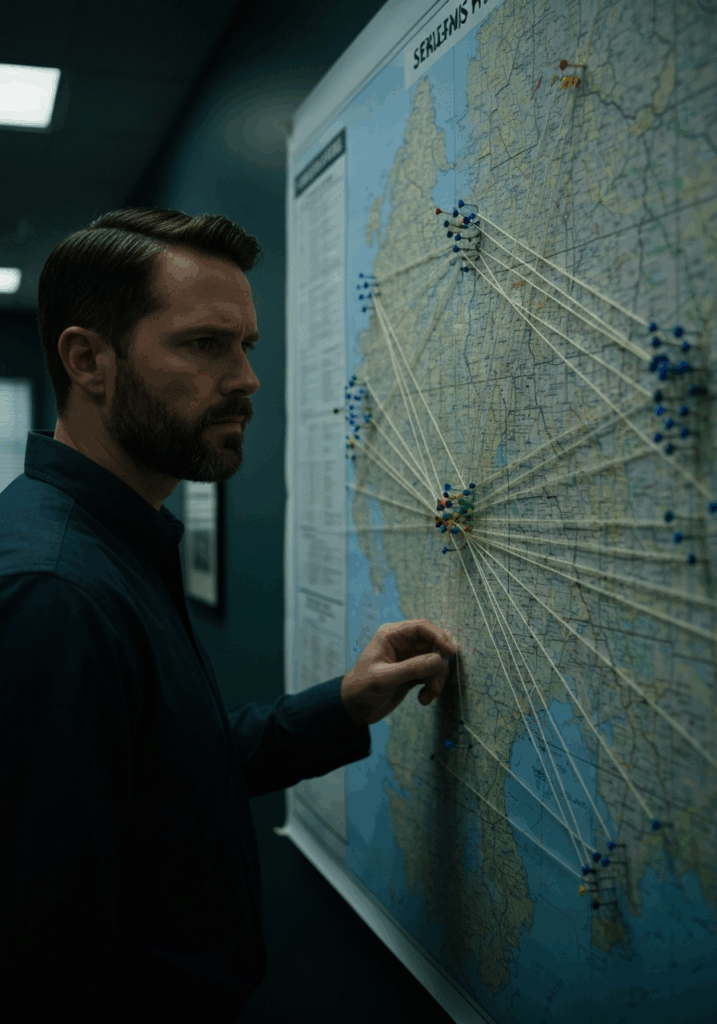
The underlying theory is that most serial offenders operate within a "comfort zone" that is often anchored by their home or workplace. By analyzing the geographic data of their crimes, law enforcement can create a map that highlights the area where the killer likely lives or frequents.
This mapping helps law enforcement in several ways:
- It prioritizes suspects by focusing on those living within the predicted area.
- It helps direct surveillance and other investigative resources more effectively.
- It can identify a "hunter" versus "trapper" style of offending, providing behavioral insights.
Advances in Digital Forensics and Surveillance
The digital age has brought about revolutionary changes in how law enforcement conducts serial killer investigations. Advances in digital forensics and surveillance have provided investigators with unprecedented access to a suspect's life and movements. Nearly everyone leaves a digital footprint, and this data can be a goldmine of evidence.
Digital forensics involves recovering and analyzing information from electronic devices like computers, smartphones, and GPS units. This can reveal an offender's internet search history, communications, location data, and even deleted files that may contain plans or incriminating information. This technology has become essential for building a timeline of a suspect's activities.
Similarly, the widespread use of surveillance cameras provides a powerful tool for tracking suspects. Video footage from public and private cameras can place a suspect at a certain location, show their vehicle, or even capture them with a victim. These technological advances have made it much harder for offenders to operate without leaving a trace.
Lessons Learned from High-Profile Serial Killer Cases in the U.S.
The history of serial murder in the United States is marked by high-profile serial killer cases that have left a lasting impact on the criminal justice system. These investigations, while tragic, have served as crucial learning experiences. They often exposed significant flaws in investigative procedures and prompted widespread reforms that have made law enforcement more effective.
By studying the murder cases of the past, from their procedural missteps to their ultimate successes, agencies have improved their methods. The evolution of serial killer statistics and investigative techniques is a direct result of the lessons learned from these challenging cases. We will explore the cases that changed procedures and where investigations are headed.
Notable Cases that Changed Investigative Procedures
Some of the most notable cases in U.S. history are remembered not just for their horror but for how they fundamentally changed investigative procedures. These cases forced the Department of Justice and law enforcement agencies to re-evaluate their approaches and develop new systems to prevent similar failures in the future.
The decline in serial killer statistics over the past few decades can be partly attributed to the lessons learned from these investigations. By identifying weaknesses in inter-agency communication, forensic analysis, and behavioral profiling, the criminal justice system has been able to adapt and improve.
Key cases that drove reform include:
- The Lindbergh Kidnapping: This case expanded the FBI’s legal authority, allowing it to take a more active role in investigating violent crimes that crossed state lines.
- The Ted Bundy Murders: Bundy's ability to kill across multiple states highlighted the desperate need for a national database, which directly led to the creation of VICAP.
Ongoing Reforms and Future Directions
The field of serial killer investigation is constantly evolving. Ongoing reforms are driven by current research, new technologies, and a better understanding of criminal behavior. Law enforcement is moving away from some older, more rigid models and embracing more nuanced and data-driven approaches to criminal justice.
For example, while the organized/disorganized dichotomy was a foundational concept, current research has shown that many offenders display a mix of traits. As a result, profiling is becoming more individualized and less reliant on broad categories. The focus is shifting toward analyzing behavioral frequency and specific patterns unique to each case.
In the future, investigations will likely rely even more heavily on DNA technology, including genetic genealogy, and advanced data analytics. The goal of these ongoing reforms is to make law enforcement more precise and effective, ensuring that even the most complex cases can be solved and justice can be delivered.
Conclusion
In summary, understanding the complexities of police procedures in serial killer investigations sheds light on the dedication and expertise required to tackle such heinous crimes. From historical approaches that have evolved over the years to the advanced techniques employed today, law enforcement agencies continually adapt to meet the challenges posed by serial offenders. The integration of behavioral analysis, technological advancements, and effective coordination among jurisdictions enhances the effectiveness of these investigations. As awareness increases around these crucial procedures, we can foster a deeper appreciation for the intricate work that goes into solving these difficult cases. If you're interested in learning more about this topic or have any questions, feel free to reach out!
Frequently Asked Questions
How do police link multiple murders to a single serial killer?
Law enforcement connects murders to a single serial killer through incident pattern analysis. This involves finding similarities in victim type, modus operandi (MO), and psychological signatures across different crime scenes. Databases like VICAP help police identify a similar case from another jurisdiction, confirming patterns in serial murder investigations.
Are there standard procedures for investigating serial murders?
While there are no rigid, one-size-fits-all procedural protocols, law enforcement agencies follow a general framework. This includes meticulous crime scene management, forensic analysis, and leveraging multi-agency task forces to overcome investigation challenges. The FBI often provides support and guidance to local agencies during serial murder investigations.
What role does behavioral analysis play in serial killer investigations?
Behavioral analysis, or criminal profiling, helps investigators narrow the suspect pool. Behavioral analysts and forensic psychologists examine crime scene clues to determine the personality, motivations, and characteristics of the offender. This psychological insight guides the direction of the investigation and is crucial for effective serial killer profiling.
https://pubmed.ncbi.nlm.nih.gov/14807904
https://api.semanticscholar.org/CorpusID:35278358
https://doi.org/10.1007/s11896-017-9238-9
https://pubmed.ncbi.nlm.nih.gov/16838388
https://api.semanticscholar.org/CorpusID:216088854
https://search.worldcat.org/issn/1359-1789
https://search.worldcat.org/issn/1544-4759
https://search.worldcat.org/issn/2331-1886
https://www.fbi.gov/stats-services/publications/serial-murder#two