Police Immigration Enforcement: What You Need to Know
 admin001
Understanding Police Immigration Enforcement in the U.S.

Key Highlights
- In the United States, immigration enforcement is mainly led by federal agencies within the Department of Homeland Security.
- Local law enforcement often focuses on public safety, not deciding a person’s immigration status on its own.
- ICE handles many stages of immigration enforcement, from identification and arrest to detention and removal proceedings.
- Some local law enforcement agencies work with ICE through 287(g) agreements.
- Cities and states use different local law responses to ICE cooperation.
- These choices can affect trust between law enforcement and immigrant communities.
Introduction
If you have ever wondered what role local police play in U.S. immigration enforcement, you are not alone. This topic can feel confusing because law enforcement duties are split between local agencies and federal agencies under the Department of Homeland Security. In many places, local police focus on public safety and community needs, while federal officials handle immigration status issues. Still, some partnerships do exist, and those arrangements shape how immigration enforcement works on the ground.
Overview of Police Immigration Enforcement in the United States
Across the United States, immigration enforcement is largely a federal responsibility. The Department of Homeland Security, through ICE, and the Bureau of Prisons, manages identification, arrest, detention, and removal for people who are subject to removal or are unlawfully present.
At the same time, local police may become involved in limited ways, especially where formal partnerships exist. ICE supports this work through nationwide field offices, specialized divisions, and coordination with federal officials and some state or local partners. That broader structure helps explain who does what.
Definition and Scope of Immigration Enforcement
Immigration enforcement refers to the process used to identify, arrest, detain, and remove people who are subject to removal or are unlawfully present in the United States. In practice, this work sits mainly within the Department of Homeland Security, especially ICE Enforcement and Removal Operations.
The scope is broad. It can involve detention management, non-detained case management, transport, case review, and coordination with field offices across the country and adherence to national detention standards. It also includes support systems such as data analysis, health services in detention, and removal planning with other agencies and international partners.
For local law enforcement, the role is usually narrower. Local police are not the main authority over immigration status. Their involvement often depends on local policy or specific partnerships, such as 287(g), where some local law enforcement agencies receive limited authority to assist with certain immigration enforcement actions.
Key Agencies Involved: Local Police vs. Federal Authorities
A simple way to understand this issue is to separate local police from federal immigration officers involved in civil immigration enforcement. Local law enforcement usually handles community crime, emergency response, and daily public safety work. Federal immigration enforcement is carried out through the federal government, mainly the Department of Homeland Security and ICE.
That difference matters because each group has a different mission, chain of command, and legal focus. Some local police departments cooperate with federal officials, but they do not replace federal immigration officers.
| Agency or Group | Main Role in Practice |
|---|---|
| Local police | Respond to crime, protect public safety, and enforce local law |
| Local law enforcement agencies in 287(g) | Assist under joint agreements in limited immigration enforcement actions |
| ICE / federal immigration officers | Handle identification, arrest, detention, and removal under federal authority |
| Department of Homeland Security | Oversees the federal immigration enforcement system |
Legal Framework Governing Immigration Enforcement
Immigration enforcement in the United States is shaped by federal law, not by a patchwork of local rules alone. That means federal immigration officials and federal immigration law set the core structure for how immigration status cases are handled and which agencies take the lead.
Still, local police practices can be affected when local agencies choose to cooperate with federal programs. In those situations, the legal framework influences what law enforcement can do, how the attorney general may view cooperation, and how far local participation can go.
Federal Immigration Laws Impacting Police Practices
Federal immigration law shapes police practices by placing primary immigration enforcement authority at the national level. In the compiled information, ICE and its Enforcement and Removal Operations, as well as state officers, carry out this mission under the Department of Homeland Security, using field offices, policy divisions, and removal systems across the country.
That federal structure affects local law enforcement when agencies enter formal partnerships such as the Immigration and Nationality Act 287(g). Under those agreements, local agencies may receive legal authority to perform certain immigration enforcement actions within their jurisdictions, but only under joint arrangements and oversight.
Federal coordination also reaches beyond arrests. Removal work may involve the Department of State, foreign embassies, consulates, and international partners. So when local police practices touch immigration matters, they do so inside a system designed and directed by federal immigration law and federal agencies.
The Authority of Immigration Officers Under 8 USC 1357
Under 8 USC 1357, immigration officers are granted authority under federal immigration law to carry out enforcement duties. In practical terms, that authority, reinforced by an executive order, supports the work done by ICE officers within the Department of Homeland Security as they identify, arrest, detain, and remove people who are subject to removal.
This matters because it shows why immigration enforcement is mainly a federal function. Law enforcement officers working for federal agencies operate under authority tied to federal statutes and agency structure, not just local practice or local policy.
The compiled information also shows that some local partnerships exist through 287(g). Even there, local agencies do not act with unlimited power. They receive specific legal authority through joint agreements, while oversight and broader enforcement direction remain with the Department of Homeland Security and its immigration officers.
The Role of Local Police in Immigration Enforcement
In most communities, local police are not the main drivers of immigration enforcement. Their core job in law enforcement is protecting public safety, responding to criminal activity, and serving the community through a local law enforcement agency.
Even so, local involvement can happen. Some departments work with ICE through specific programs, while others limit cooperation to protect trust with immigrant communities. That tension raises an important question: can local police enforce federal immigration laws independently, or only under narrow federal arrangements?
Types of Police Involvement in Immigration Matters
Local law enforcement can become involved in immigration matters in different ways, but the compiled information shows that this usually happens through cooperation with federal systems rather than through a fully separate local process. In many places, police still focus first on criminal activity and everyday community safety.
Where formal cooperation exists, law enforcement officers may assist in identifying people who could be subject to removal proceedings. That is most clearly described in the 287(g) program, which allows some local agencies to perform limited immigration enforcement actions within their jurisdictions.
Common types of involvement include:
- Working with ICE under 287(g) joint agreements
- Sharing operational support with federal partners
- Helping identify individuals linked to criminal activity
- Referring cases that may lead to removal proceedings
- Following local policy on whether officers ask about immigration status
Can Local Police Enforce Federal Immigration Laws?
The compiled information points to a careful answer: local law enforcement officials do not generally take the lead in federal immigration law on their own. Immigration enforcement is structured as a federal responsibility, with ICE and the Department of Homeland Security directing the process.
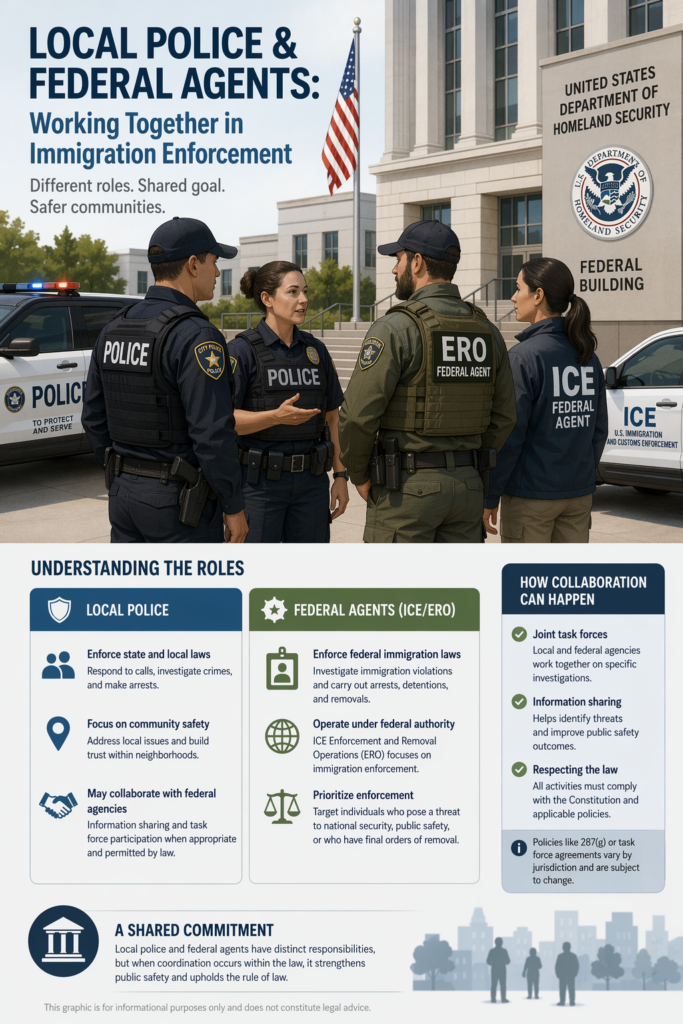
Local law can shape whether cooperation happens, but it does not turn local police into full federal immigration authorities. When law enforcement officers assist, that help usually comes through specific programs such as 287(g), where legal authority is granted under joint agreements and oversight.
That distinction is important for communities and policymakers. It means local departments do not simply step into the federal role independently. Questions about how far they should cooperate often involve local policy choices, public safety concerns, and broader positions taken by local leaders or the attorney general.
Immigration and Customs Enforcement (ICE) Operations
ICE is the main federal agency carrying out much of the country’s immigration enforcement work. Under the Department of Homeland Security, ICE officers manage operations tied to arrest, detention, supervision, and removal.
Nationwide, this system runs through 24 field offices and several divisions that support customs enforcement and immigration enforcement tasks. Those offices coordinate domestic activity, detention management, removals, analysis, and special operations. To understand how the agency works in practice, it helps to look more closely at its nationwide methods and ERO’s role.
How ICE Conducts Immigration Enforcement Nationwide
ICE conducts immigration enforcement nationwide through Enforcement and Removal Operations, often called ERO, including ICE Air Operations. According to the compiled information, ERO manages identification, arrest, detention, and removal for people subject to removal or unlawfully present in the United States. That makes it a central part of the federal system.
Its structure is broad and organized. ICE officers work through 24 field offices supported by divisions for enforcement, custody management, non-detained management, operations support, removal, and law enforcement systems analysis, including the essential ICE Health Service Corps. These parts help the Department of Homeland address daily cases and larger operational demands.
ERO also connects immigration enforcement to national security planning. Special operations support intelligence collection, tactical programs, and incident response for major emergencies, including natural disasters and terrorist attacks. This gives ICE a nationwide framework instead of a city-by-city approach.
Enforcement and Removal Operations (ERO) Explained
Enforcement and Removal Operations (ERO) is a division within the Department of Homeland Security that focuses on immigration enforcement actions. ERO works closely with local law enforcement agencies to locate and detain individuals, including illegal immigrants, who are unlawfully present in the United States. Through targeted operations, they aim to ensure public safety and uphold federal immigration laws. This includes processing removal proceedings and managing individuals' immigration status, fostering cooperation with local officials to address community concerns effectively.
Immigrant Rights During Police Immigration Enforcement
When immigration enforcement involves a law enforcement agency, people often want clear, practical information about rights and next steps. For immigrant communities, that includes understanding where to get reliable help and how to protect sensitive information.
The compiled information does not give a full rights checklist, but it does point to official support channels. ICE provides case contact options, local field office review requests, and official website guidance. Knowing where to turn can make a stressful situation easier to manage, no matter a person’s citizenship status.
Rights and Protections for Immigrants in Police Encounters
During encounters involving law enforcement officers, one of the most practical protections is getting information from official sources and avoiding the spread of sensitive information through unofficial channels. The compiled information stresses using secure government websites and official contact points when immigration status issues arise.
Another key protection is knowing that immigration matters are handled through structured federal systems, including field offices and case review processes. If a case is active, official channels may help you understand what is happening and whether further action, such as review or legal support, is needed.
Helpful steps include:
- Use official, secure government websites before sharing sensitive information
- Contact ICE or a local field office for case-related updates
- Request a case review through the proper field office process when available
- Seek legal support if police contact may affect immigration status or involve a court order
Accessing Information and Legal Support for Immigrants
If you need information about immigration status or enforcement activity, start with official government sources. The compiled information highlights secure .gov websites, ICE contact options, local field offices, and social media as key places to find case-related details. That can help immigrant communities avoid confusion and misinformation.

ICE also provides ways to contact ERO about an immigration or detention case. In some situations, a person may request a case review through a local field office. Those channels are especially important when someone needs updates tied to detention, removal, or supervision.
Legal support is also important. While the compiled material does not list private providers, it clearly shows that immigration matters can involve several agencies, including the Department of State during removal coordination. Because the system is complex, timely legal support can help people understand paperwork, deadlines, and agency communication.
Local Policy Responses to Immigration Enforcement
Cities and states respond to immigration enforcement in different ways, including New York City. Some local law enforcement agencies choose more cooperation with federal programs, while others adopt local law or policy limits to preserve community trust and focus local government resources on public safety.
The compiled information notes that places such as New York and New Orleans have, at times, declined to participate in aspects of immigration enforcement. Debates around measures such as a California Senate Bill or similar proposals often center on how much local agencies should work with ICE.
Common City and State Policies: Sanctuary Cities Explained
Sanctuary cities are often discussed as places where local policy limits how much local agencies assist with federal immigration enforcement. The compiled information does not define the term in a technical legal way, but it does show that some cities and states choose to decline participation in certain enforcement activities.
Supporters of these local policy choices often point to public safety concerns. The material provided says many police leaders worry that local immigration enforcement can damage trust with immigrant communities, reduce crime reporting, and weaken community policing. That concern has shaped decisions by some local law enforcement departments.
Examples in the compiled information include Chicago, New York, New Jersey, and New Orleans. These choices do not remove the role of federal officials, but they can limit how much local agencies cooperate, especially when leaders believe stronger separation helps improve trust and communication.
Police Cooperation and Information Sharing With ICE
Police cooperation with ICE can take several forms, from formal program participation to narrower case contact. The clearest example in the compiled information is 287(g), where a law enforcement agency enters a joint agreement allowing certain local law enforcement officers to perform limited immigration enforcement actions.
Information sharing may also happen through operational coordination and support systems. ICE relies on field offices, analytical centers, and enforcement units to generate leads on people subject to removal. In places with cooperation, local agencies may interact with that federal structure rather than running separate immigration systems themselves.
At the same time, some cities and departments choose to limit cooperation. The compiled material links those limits to concerns about community trust, racial profiling, cost, and reduced crime reporting. So information sharing with ICE often depends on local priorities, not just federal interest.
Conclusion
Understanding police immigration enforcement in the U.S. is crucial for navigating the complex interactions between local law enforcement and federal immigration agencies. As we have explored, this enforcement landscape is influenced by various legal frameworks and policies that dictate how and when local police can engage in immigration matters. Immigrants need to be aware of their rights and protections during these encounters, including an individual’s immigration status, as well as the resources available for legal support. By being informed about these dynamics, individuals can better prepare themselves should they find themselves in situations involving police and immigration enforcement. To further your understanding, don’t hesitate to reach out for more information or assistance regarding your rights.
Frequently Asked Questions
What is the difference between ICE and local police in immigration enforcement?
ICE is a federal agency within the Department of Homeland Security and leads immigration enforcement, including detention and removal, while also coordinating with U.S. Customs and Border Protection for border protection. Local police are part of local law enforcement and mainly handle public safety and crime response. They may assist ICE in limited ways, but they do not usually serve as the main immigration authority.
Where can immigrants learn about their rights during police enforcement actions?
Immigrants can start with official government sources, especially secure .gov websites, ICE contact channels, and local field offices. These sources can help with immigration enforcement questions and case updates. Because the system is complex, legal support is also important, particularly when issues may involve detention, removal, or the Department of State.
What happens if local police detain someone for immigration reasons?
If local police detain someone in connection with immigration status, the case may move into the federal courts system handled by ICE and other federal officials. That can lead to detention review, transfer, or removal proceedings, depending on the case and whether the local agency is cooperating under a formal program.
https://www.nytimes.com/2019/05/05/us/politics/trump-ice-mark-morgan.html
https://www.nytimes.com/2025/01/22/us/trump-biden-immigrants-deportations.html
https://www.nytimes.com/2025/10/16/us/politics/justice-department-terrorism-antifa.html
https://www.ice.gov/sites/default/files/documents/Document/2016/I-247D.PDF
https://www.ice.gov/leadership
https://www.ice.gov/sites/default/files/documents/Document/2017/I-200_SAMPLE.PDF
https://www.nytimes.com/2026/01/12/podcasts/the-daily/minneapolis-police-chief-ice-shooting.html
https://www.ice.gov/sites/default/files/documents/Document/2017/I-205_SAMPLE.PDF